
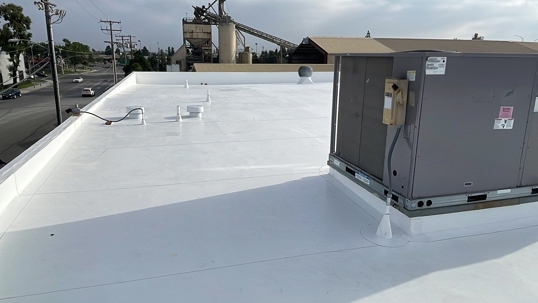
This article is for facilities and finance teams evaluating a commercial roof CapEx in Southern California. It is educational, not tax, legal, or engineering advice. Qualification, dollar limits, and state conformity depend on your facts and your tax year. Confirm every deduction and model with your CPA or tax counsel before you book a number.
For a facilities director, a commercial roof is weather protection, tenant continuity, and warranty risk. For a CFO, it is CapEx timing, cash tax, operating expense, and residual asset life. In Southern California — Long Beach, Los Angeles County, Orange County, and the inland valleys — those two jobs meet on one deck: UV, heat load, marine air on the coast, and Title 24 cool-roof rules on many low-slope replacements.
BYLTup is a commercial roofing contractor headquartered in Long Beach. We are a GAF GoldElite™ commercial contractor and an IB Roof Systems Tier 1 contractor. We specify and install commercial flat and low-slope systems — including IB PVC cool roofs and GAF commercial TPO and coating assemblies — for offices, industrial buildings, multi-family, retail, and HOA properties. This post is written for the people who have to defend the spend in a capital committee: what is financially true in 2026, what is often oversold, and how to run a lifecycle decision instead of a lowest-bid decision.
1. The tax story — say it accurately
You will see marketing that says “100% tax depreciation on your new commercial roof.” That phrase is too blunt. The honest version has three layers: Section 179, bonus depreciation under Section 168(k), and California’s separate rules.
Section 179: where many nonresidential roofs actually get first-year expensing
Under the Internal Revenue Code, taxpayers may elect to expense certain “qualified real property.” That definition includes qualified improvement property and specific improvements to nonresidential real property placed in service after the building was first placed in service — explicitly including roofs, HVAC property, fire protection and alarm systems, and security systems.
That is the lane most relevant to a like-for-like or upgrade commercial roof replacement on an existing nonresidential building. It is an election. It is subject to annual dollar limits, a phaseout when total qualifying property placed in service exceeds a threshold, and a taxable-income limitation. It is not automatic.
The One Big Beautiful Bill Act (OBBBA / P.L. 119-21), signed July 4, 2025, expanded federal Section 179 for taxable years beginning after 2024, with inflation indexing afterward. For tax years beginning in 2026, Rev. Proc. 2025-32 sets the federal Section 179 maximum at $2,560,000 and the phaseout threshold at $4,090,000. Those limits are why “write off a large qualifying roof in year one” is a real planning conversation again for many mid-market owners — if your CPA confirms the roof qualifies, the building is nonresidential for this purpose, placed-in-service timing works, and you have enough taxable income to use the election.
100% bonus depreciation: real law — usually not the whole roof
OBBBA also permanently restored 100% bonus depreciation under Section 168(k) for qualified property acquired and placed in service after January 19, 2025. That is a major federal capital-cost recovery change. It applies broadly to tangible property with a recovery period of 20 years or less (and certain other listed categories), including much equipment and many shorter-life assets.
Here is the transparent part competitors often skip: a commercial roof as a structural building component is generally not Qualified Improvement Property. QIP is defined as improvements to an interior portion of nonresidential real property; the statute excludes enlargement, elevators/escalators, and internal structural framework — and IRS / practitioner guidance treats roofs, windows, doors, and similar exterior structural work as outside QIP. Property that stays on a 39-year nonresidential real property recovery period does not get pulled into 100% bonus simply because bonus is “back.”
So when someone says “100% depreciation on your roof,” ask which tool they mean:
- Section 179 election on a qualifying nonresidential roof improvement — often the real first-year path for the membrane package itself.
- Bonus depreciation on shorter-life assets that a proper cost-segregation analysis supports inside the same project (certain personal property / land-improvement items, where documentation holds) — not a blanket label on every square foot of membrane.
- Ordinary MACRS over 39 years if neither election applies or you elect out for planning reasons.
Placed-in-service timing matters. For bonus property, acquisition after January 19, 2025 and placed-in-service rules apply; binding-contract dates can control. For Section 179, the improvement must be placed in service in the tax year of the election, after the building’s original placed-in-service date. Your CPA should model calendar-year vs fiscal-year effects before you lock a contractor schedule around “get it done this year.”
California: do not blend federal and state
If your entity files California franchise or income tax, assume decoupling until your tax advisor says otherwise. California updated its general IRC conformity date but does not incorporate OBBBA, and it historically does not conform to federal Section 168(k) bonus depreciation or the enhanced federal Section 179 limits. California’s own Section 179-style expense limit remains much smaller — commonly cited at a $25,000 maximum with a phaseout beginning once qualifying property placed in service exceeds $200,000 (confirm current FTB figures with your CPA). The Franchise Tax Board still requires federal/California depreciation difference tracking on forms such as FTB 3885A when methods diverge.
Practical CFO takeaway: a federal first-year federal benefit does not automatically equal a California first-year benefit. Run a two-column cash-tax model (federal vs California) on any CapEx memo that leads with depreciation. Owners who only quote a blended rate will overstate year-one relief for California-situs property.
BYLTup does not prepare tax returns or issue tax opinions. We will coordinate placed-in-service documentation, manufacturer warranties, and project cost detail so your CPA and, if used, your cost-segregation firm have clean inputs. The deduction is theirs to confirm.
2. Lifecycle cost — the number CapEx committees should actually compare
Tax timing moves cash. Lifecycle cost decides whether the asset was cheap or expensive over 15–30 years. A low bid that forces recoats, emergency leak calls, tenant credits, and an early tear-off is not a savings.
A useful facilities + finance frame for Southern California commercial roofs:
- First cost — tear-off vs recover (where structurally and warrantably allowed), membrane type, insulation / cover board, flashings, drains, rooftop equipment curbs, fall protection, and disposal.
- Energy operating cost — roof surface temperature drives cooling load on many low-slope buildings here; cool-roof assemblies and insulation upgrades change kWh and often peak demand.
- Maintenance and disruption — patch cycles, interior damage from deferred leaks, after-hours emergency rates, and tenant / production downtime.
- Warranty and residual risk — manufacturer-backed NDL-style coverage on qualifying systems (for example, GAF Diamond Pledge™ NDL on qualifying GoldElite path systems, or IB Total System / NDL on qualifying PVC with Notice of Award and inspection) vs short contractor-only workmanship lines.
- End-of-life and recoverability — whether the next cycle can recover again, or whether today’s thin system forces a full tear-off in 12 years.
When you compare bids, ask each contractor for the same lifecycle worksheet: expected service life under SoCal UV and heat, maintenance plan, cool-roof / Title 24 compliance path, and which manufacturer warranty the assembly can actually register — not which brochure name appears in the proposal. BYLTup builds commercial scopes so qualifying assemblies can pursue those manufacturer programs; eligibility is always defined by the manufacturer’s documents.
3. Energy-efficient roof upgrades — real savings, honestly bounded
Southern California commercial buildings live on cooling. A dark, aged membrane absorbs solar heat; a high-reflectance cool roof rejects more of it. The 2025 California Energy Code (Title 24, Part 6), effective January 1, 2026, continues to push most nonresidential low-slope new construction and qualifying re-roofs toward CRRC-rated cool-roof products — commonly aged solar reflectance ≥0.63 and thermal emittance ≥0.75, or SRI ≥75 (confirm the exact path for your climate zone and alteration scope). Meeting code is table stakes. Beating heat gain is where OpEx shows up.
What the research supports — as ranges from published California studies, not as a promise on your building:
- Field monitoring of cool roofs on California commercial buildings has documented meaningful air-conditioning energy reductions in specific sites and seasons (for example, on the order of mid-teens percent AC energy reduction in a monitored school building period in San Marcos, with larger relative savings on hotter days).
- DOE-2 / California Energy Commission–oriented analyses of nonresidential cool roofs have estimated average annual cooling electricity savings on the order of roughly a few kWh per square meter of roof (on the order of hundreds of kWh per 1,000 ft² in some prototypes), plus peak-demand reductions — with results varying hard by climate zone, insulation, HVAC efficiency, and operating schedule.
- Inland and hotter Title 24 climate zones generally show stronger cooling benefits than mild coastal zones; heating penalties are usually small in SoCal cooling-dominated commercial stock, but they should still be modeled when relevant.
Translate that for a CapEx memo: treat energy savings as a modeled OpEx sensitivity (low / base / high) using your utility rates (SCE, LADWP, SDG&E, or others), your peak demand charges, and a roof reflectance / insulation package your engineer or energy modeler will stand behind. Do not paste a national “20% HVAC savings” claim into a board deck. BYLTup can help specify cool-roof membranes and insulation details that support Title 24 compliance and a defensible energy story; your energy model or utility program rules own the kWh math.
Also ask about utility or local incentive programs when you scope the job — offerings change, and cool-roof or envelope incentives are not always available. Some municipal utilities (for example, LADWP custom building-performance / envelope pathways) may support envelope measures with pre-approval; we will not invent statewide IOU cool-roof rebate dollars. We will flag known paths when we see them; your account rep and program paperwork own eligibility.
4. Why “this year” still matters — even with permanent federal bonus
Permanent 100% federal bonus depreciation removes some of the old “use it or lose it” panic for bonus-eligible assets. It does not remove urgency for a facilities team sitting on a leaking or end-of-life commercial roof:
- Section 179 and taxable income — first-year expensing only helps if you can use it. A profitable year plus a placed-in-service roof can align; a delayed project can miss the year your model assumed.
- Construction and permit calendars — coastal and urban SoCal jurisdictions, occupied buildings, and HOA / multi-tenant access windows slip. “Start in Q4, place in service next year” is a tax and ops decision, not a contractor preference.
- Failure cost — emergency interior damage, mold remediation, spoiled inventory, and tenant claims rarely appear in the low bid. They dominate the true lifecycle cost.
- Energy rates and peak charges — every cooling season on a failed reflectance surface is OpEx you do not get back.
- Manufacturer warranty windows — systems specified and inspected to earn NDL-style manufacturer coverage protect residual value; waiting until the deck is compromised can force more invasive repairs and narrower warranty options.
“This year” is strongest when your CPA sees a clean federal §179 (and any cost-seg) story, your California model is honest about decoupling, and operations can no longer defend another patch season.
5. A one-page checklist for the FD / CFO packet
- Building use: nonresidential vs residential rental (affects §179 roof category).
- Desired placed-in-service tax year and fiscal year ends.
- Federal model: §179 vs MACRS; any cost-segregation scope; bonus only on assets that actually qualify.
- California model: separate depreciation / §179 limits; no assumed federal bonus conformity.
- Lifecycle: service life, maintenance, disruption, and manufacturer warranty path (GAF / IB or other as specified).
- Energy: Title 24 cool-roof path, CRRC product, modeled kWh / demand sensitivity — labeled as model, not guarantee.
- Ops: occupied-building phasing, drain and curb details, fall protection, and inspection schedule for warranty registration.
Talk to BYLTup
If you are a facilities director or CFO planning a commercial roof in Long Beach, Los Angeles County, Orange County, or nearby Southern California markets, we will help you build a scope that stands up in both the field and the capital packet: right membrane for the climate, cool-roof and insulation details that support code and energy goals, and a manufacturer warranty path worth registering — with project documentation your tax advisors can use.
Request a commercial assessment: byltup.com/commercial-roofing or call (562) 414-4425.
Again: BYLTup is a roofing contractor. We do not provide tax advice. Confirm Section 179, bonus depreciation, cost segregation, 179D, and California conformity with your CPA or tax counsel.