
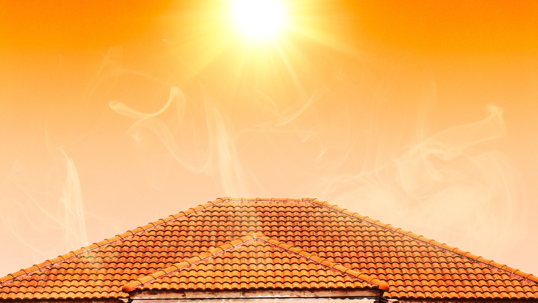
California's Building Energy Efficiency Standards — part of Title 24 of the California Code of Regulations — set minimum performance requirements for buildings and homes, including their roofs. The goal is straightforward: reduce energy consumption, lower cooling costs, and ease demand on the state's power grid.
These standards apply to new construction, additions, and qualifying alterations to existing buildings. That last point surprises a lot of people — a re-roofing project on an existing home or commercial property can trigger energy efficiency requirements, depending on the scope of work.
The Cool Roof Requirement
The most important energy efficiency rule for roofing in California is the cool roof requirement. Cool roofs are designed to reflect more sunlight and release heat more efficiently than standard roofing materials — keeping buildings cooler naturally and reducing the need for air conditioning.
Performance is measured by two values:
- Solar Reflectance (SR): How much sunlight the roof reflects. Higher is better.
- Thermal Emittance (TE): How efficiently the roof releases absorbed heat. Higher is better.
These are sometimes combined into a Solar Reflectance Index (SRI) — a single score that captures overall energy performance.
When does it apply? For most residential projects, cool roof requirements kick in when 50% or more of the roof is being replaced. For commercial and multifamily buildings, the trigger is 50% of the roof area or 2,000 square feet, whichever is less.
Any roofing product used for compliance must be listed in the Cool Roof Rating Council (CRRC) Rated Products Directory — so make sure your contractor is specifying CRRC-certified materials.
Insulation Requirements
Beyond the roof surface itself, California also requires minimum levels of roof insulation, which is the material installed within or above the roof assembly that slows heat from transferring into the building. Think of it like a thermal blanket: the higher the R-value, the better it resists heat flow and the less work your HVAC system has to do.
R-value is categorized on a numerical scale, where a lower number (like R-10) represents a basic level of insulation, and a higher number (like R-38) represents a much stronger thermal barrier, meaning significantly more heat resistance and better energy efficiency overall.
For commercial and multifamily buildings, low-slope roof replacements require a minimum of R-10 above-deck continuous insulation. If the existing roof is being fully torn off, that requirement increases to R-17 to R-23 depending on your climate zone. The hotter the region, the higher the standard.
For residential buildings, requirements are more flexible. A cool roof may not be required if your attic already has R-38 or greater insulation, or if a qualifying radiant barrier is in place.
Does Your Project Qualify for an Exemption?
Not every roofing project triggers these requirements. Common exemptions include:
The roof area being replaced is less than 50% of the total surface
The existing roof already has R-10 or greater continuous insulation above the deck
The roof area is covered by solar panels (though uncovered areas still must comply)
Roofing and Solar: Better Together
For homeowners and property owners thinking about long-term energy efficiency, roofing and solar work best when planned together. A cool roof reduces how much heat enters your building, and solar offsets the energy you do use. It’s a powerful combination that can meaningfully reduce your monthly utility bills.
The 2025 energy code now requires solar PV systems on most new residential construction in California, and for existing properties, combining a roof replacement with solar installation is one of the smartest energy upgrades you can make.
How BYLTup Can Help
Navigating energy efficiency requirements is a lot easier with an experienced contractor by your side. BYLTup is a family-owned roofing company based in Long Beach with over 15 years of experience serving Southern California homeowners and businesses. As a GAF Master Elite Contractor and Certified IB Roof Systems installer, BYLTup installs CRRC-certified roofing products, handles permit coordination, and offers fully integrated roofing and solar services — so you get a compliant, high-performing roof without the guesswork.
BYLTup serves Long Beach, Los Angeles, Orange County, Pasadena, Malibu, Manhattan Beach, the Coachella Valley, and surrounding communities.
Ready to Get Started?
Whether you're replacing a roof, planning a solar install, or just trying to better understand what Title 24 is, BYLTup is here to help. Call (562) 800-5620 or visit byltup.com for a free estimate.
The BYLT in BYLTup stands for Build Your Long-Term — and that's how we approach every project.
Sources
California Energy Commission — 2025 Building Energy Efficiency Standards — energy.ca.gov
Cool Roof Rating Council — California Title 24 Requirements — coolroofs.org
BayREN — Residential & Nonresidential Roofing Energy Code Guides — bayren.org