
Embers travel. That’s the detail most Southern California homeowners don’t realize until they’re researching roofing materials after a close call or an insurance notice. In a wildfire, burning firebrands can drift well over a mile ahead of the fire front and land on rooftops, in gutters, and against eave edges long before any visible flame arrives. The roof is almost always the first surface exposed, and what it’s made of determines whether that ember dies or catches.
That reality has moved from safety advice into law. The 2025 California Wildland-Urban Interface Code (Title 24, Part 7), which took effect January 1, 2026, expanded Class A roofing requirements into mapped High and Very High Fire Hazard Severity Zones within city limits that were previously exempt. For hundreds of thousands of California homeowners who assumed code requirements didn’t apply to them, that changed. Material selection is now a code compliance decision, an insurance decision, and a safety decision all at once.
As a GAF Master Elite Roofing Contractor serving Long Beach, Orange County, and the broader Southland, BYLTup installs every Class A material type covered in this post. Here’s what you need to know before choosing one.
Why Southern California Roofs Face a Different Fire Standard
Southern California’s fire risk isn’t limited to remote mountain communities. Neighborhoods in Orange County, including Anaheim Hills, Yorba Linda, Rancho Santa Margarita, Laguna Hills, and Trabuco Canyon, sit near dry hills and canyon corridors that have produced some of the region’s most destructive fire events. Even Long Beach, which is predominantly coastal and urban, has hillside areas near Signal Hill that may fall within Fire Hazard Severity Zone (FHSZ) designations under the 2025 Local Responsibility Area map update.
The FHSZ system, administered by CAL FIRE, classifies land into Moderate, High, and Very High designations based on fuel, slope, fire weather, and ember production. Homeowners can look up their property’s current designation using the CAL FIRE FHSZ viewer at osfm.fire.ca.gov. Properties in High or Very High zones are now subject to Class A roofing requirements under the expanded code, even if they sit within city limits previously exempt from WUI standards. Embers don’t need a flame front to ignite a home. They need a combustible surface and enough time to smolder, which is exactly why the code focuses on the roof.
What Class A Actually Means and Why the Distinction Matters
Roofing materials are rated under ASTM E108 and UL 790 testing standards, which measure how a product performs under severe, moderate, and light fire exposure. The three resulting classifications are Class A (severe exposure), Class B (moderate), and Class C (light). Class A is the legal minimum for re-roofing in mapped FHSZs under the current California Wildland-Urban Interface Code.
There’s a distinction within Class A that most material comparison guides skip entirely: standalone vs. assembly-rated.
- Standalone Class A: The material achieves Class A by its own composition regardless of what’s beneath it. Clay tile, concrete tile, metal, and slate fall into this category because they’re inherently non-combustible.
- Assembly-rated Class A: The material achieves Class A only when installed as a complete system with a qualifying underlayment. Many fiberglass-reinforced asphalt shingles earn their Class A rating this way.
The practical consequence is significant. A product marketed as “Class A rated” can lose that rating in the field if it’s installed with a non-qualifying underlayment. California building inspectors and insurers look at documented assemblies, not just the surface material on the invoice. That’s one reason why the installer’s familiarity with California code requirements matters as much as the material itself.
The Best Fire-Resistant Roofing Materials for Southern California Homes
Each material below achieves Class A fire resistance and carries characteristics that make it well-suited to Southern California’s climate, architecture, and code environment. Tradeoffs exist, and the right choice depends on your home’s structure, style, and budget.
Clay & Concrete Tile
Both materials are inherently non-combustible, earning standalone Class A ratings with no assembly dependency. They fit naturally with the Spanish and Mediterranean architecture common across Southern California and can last 50 years or more with proper maintenance. The tradeoff is weight: clay and concrete tile impose significant structural loads, so a professional evaluation of your roof deck and framing is necessary before installation. Concrete tile is generally the more cost-accessible option; clay adds aesthetic warmth at a premium price point.
Metal Roofing
Steel and aluminum roofing products, including standing seam panels, are non-combustible and achieve standalone Class A. Metal also sheds embers rather than catching them in surface texture, which matters in ember-heavy fire events. A metal roof typically carries a 40-to-70-year lifespan and offers reflective surface properties that reduce cooling loads during hot inland months. Slate is similarly non-combustible but carries significant installation weight and cost that places it out of range for many residential projects.
Fiberglass-Reinforced Asphalt Shingles
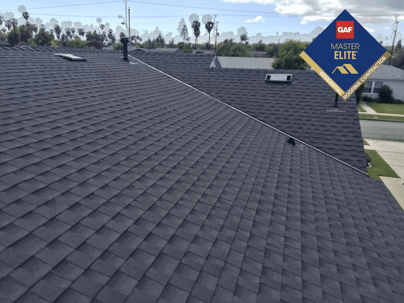
Class A fiberglass-core asphalt shingles are the most accessible entry point for fire compliance and the most widely installed roofing material in the country. Unlike older organic-mat shingles, fiberglass-reinforced products achieve Class A by assembly when paired with a qualifying underlayment system. GAF Timberline HDZ shingles are a strong example: they deliver Class A fire resistance in a complete assembly, with performance characteristics well-suited to Southern California’s temperature swings and coastal conditions. As a GAF Master Elite Roofing Contractor, we install these shingles with a lifetime warranty, a 50-year Smart Choice Protection Period, and a 15-year wind warranty backed by the manufacturer.
Fire Resistance Is a System, Not Just a Material
Choosing a Class A material is the necessary first step. It isn’t the last one. The 2025 California Wildland-Urban Interface Code requires the entire roofing assembly to achieve Class A status, not just the surface layer. That means underlayment selection, eave and soffit details, attic ventilation, flashing, and gutter conditions all contribute to whether the roof performs as rated in a real fire event.
Cracked tiles, gaps in flashing, loose shingles, and gutters packed with dry debris are documented ember entry points. An ember that reaches a gap in flashing or slips under a lifted shingle edge can ignite roof deck material even when the surface covering is rated Class A. Annual inspections, particularly before Southern California’s fall fire season, catch these vulnerabilities while repairs are still straightforward.
For homeowners with rooftop solar, re-roofing adds a layer of complexity. Panels must be removed before the roof can be replaced and reinstalled properly afterward. We’re one of only a small number of roofing contractors who handle solar removal and reinstallation directly, which means no coordination with a second contractor, no scheduling gaps, and continuous accountability for the completed system.
How Your Roof Choice Affects Insurance Coverage in California
California’s insurance market has contracted sharply in mapped wildfire zones. Several major carriers have stopped writing new policies or declined renewals for properties they consider underprotected, and documented roof fire ratings have become one of the clearest factors in those decisions. Homeowners in mapped FHSZs who can’t provide documentation of Class A roofing may face policy non-renewal, higher premiums, or placement in the California FAIR Plan, the state’s insurer of last resort.
Documentation matters as much as the material itself. A GAF Master Elite contractor can register the installed system warranty with the manufacturer, creating verifiable, manufacturer-backed records of Class A assembly compliance. Insurers are increasingly asking for that documentation specifically, and it adds value for future buyers who want confidence in the roof they’re inheriting.
One material category is worth calling out explicitly: wood shake and wood shingle roofing is prohibited under the 2025 California Wildland-Urban Interface Code for any property in a mapped Fire Hazard Severity Zone. Homeowners with existing wood roofs in these zones face both a code compliance issue on re-roofing and a growing challenge obtaining or renewing insurance coverage. Replacing an aging wood roof in these areas isn’t just a maintenance decision. It’s a protection of insurability.
A fire-resistant roof in Southern California isn’t an upgrade. Under current code and insurance conditions, it’s the baseline. Choosing the right Class A material, installed as a complete compliant assembly, is what makes that baseline real. We’re licensed, bonded, and insured, and our GAF Master Elite status covers every material discussed here. We serve Long Beach, Orange County, and across the Southland. Reach us at (562) 414-4425 to talk through which option fits your home.